
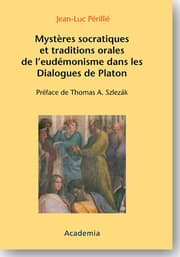
Mystères socratiques et Traditions orales de l'eudémonisme dans les Dialogues de Platon
Alber Philosophical Studies 49
€49.00
(inklusive MwSt.)
Verfügbarkeit: Besorgungstitel, Festbezug
Zusatztext
In Apologia, Plato first represented Socrates as a transparent philosopher who had nothing to hide. Later, in the Theaetetus and other dialogues, he describes Socrates' midwifery as shrouded in mystery. In doing so, Plato moves decidedly closer to the previous, 'rather esoteric' depiction of Socrates established by Aristophanes. Basing itself on both the study of the oft neglected correspondences between the two depictions, as well as the examination of the 'oral structures' recurring in Plato's Socratic dialogues, the first objective of this book is to attempt to obtain a better understanding of the 'Socratic phenomenon' in all its complexity. The second aim is to propose an unprecedented attempt to reconstruct the 'Socratic Mysteries': during the discussions with his disciples, Socrates could be possessed by the divine gift (theia moira) and a demonic wisdom (diamonia sophia). By uttering the legomena (obscure and secret Orphic words about eudaimonia, salvation of soul), he transposed the tradition, drawing new meanings. As a philosopher (unlike Orphic priest-beggars or hierophants) he was also able to make explicit the meaning of the inspired words he spoke, through dialogue (dialegesthai). Socrates' cathartic practices of refutation (elenchus) and his fulgurant intuitions produced the greatest effect on the disciples, who became in their turn 'struck and possessed'. As seeds of truth (spermata), these intuitions marked the starting point of the maieutic process.
Autorenportrait
Jean-Luc Périllié est maître de conférences en philosophie ancienne à l'Université Paul Valéry (Montpellier III). Il a publié de nombreux articles, un ouvrage sur l'origine pythagoricienne de la notion de symétrie (2005) et dirigé l'édition d'ouvrages collectifs sur Platon et les Pythagoriciens (2008) et sur l'Oralité et l'écriture chez Platon (2011).
Weitere Details
Erschienen: 15.02.2015
Umfang: 524 S.
Sprache: FRE
Einband: KT
Format: 3.3 x 22.5 x 15.6 cm
ISBN/EAN: 9783896656650
Umbreit-Nr.: 7805721
