
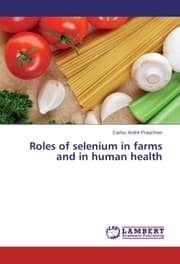
Roles of selenium in farms and in human health
LAP Lambert Academic Publishing
€79.90
(inklusive MwSt.)
Verfügbarkeit: Titel wird für Sie produziert, Festbezug, bitte vormerken
Zusatztext
The selenium is a micronutrient essential to the perfect growth of plants and animals and by preventing health problems in human population. In plants, selenium acts as an antioxidant by preventing oxidative stress due excessive solar radiation. Animals obtain the micronutrient from roughages and grains and take benefits from selenium supplementation by increasing immune surveillance, improving udder health and ameliorating reproductive performance. Fertilizing selenium to soils is the most ample and security way to increase selenium status of the human population. Among agronomic plants, vegetables into Brassica and Allium genders, as garlic, onion, leek, mustard and broccoli are some carriers of the micronutrient to human diet. Among crop plants, wheat and rice, although generally containing low levels of selenium, are more appropriated crops to be introduced in agronomic biofortification. In Brazil, specifically in the Amazon forest, there are trees that produce a natural selenium-enriched fruit, called Brazilian nut. In people, selenium acts as an antioxidant by delaying the aging, mitigating heavy metals poisoning and preventing cardiovascular diseases and cancer.
Autorenportrait
Carlos André Prauchner is graduated in Veterinary (Bachelor's degree) and is Licentiate in Education of Professional Courses of Technician Level (Rural Sciences). He has also degrees of Specialization in Diary Cattle Production, Master and Doctor in Biological Sciences (Toxicological Biochemistry) and Post-Doctor in Nutrition of Ruminants.
Weitere Details
Erschienen: 31.07.2015
Umfang: 356 S.
Sprache: ENG
Einband: KT
Format: 2.2 x 22 x 15 cm
ISBN/EAN: 9783659750502
Umbreit-Nr.: 8494118
