
Impact of anthropic activities on carbon sequestration
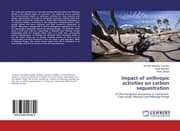
of the mangrove ecosystem in Cameroon, Case study: Manoka and Mbanga Pongo
Tchanou, Armelle Verdiane/Ngonkeu, Eddy/Jiofack, René
LAP Lambert Academic Publishing
€54.90
(inklusive MwSt.)
Verfügbarkeit: Titel wird für Sie produziert, Festbezug, bitte vormerken
Zusatztext
The study was carried out in two sites notably Manoka Island and Mbanga Pongo in the Littoral region of Cameroon. The objective was to evaluate the environmental impact of anthropic activities on trees diversity and carbon sequestration potential of mangrove ecosystem. Results reveal that the floristic inventories conducted to obtain 833 individuals belonging to 13 botanical families. According to the mangroves characterization, some woody species has been recorded and their frequency dispatched as follow: Rhizophora mangle (58 %; 60 %), Rhizophora racemosa (21 %; 36 %) respectively in Manokas island and Mbanga Pongo. The Shannon index value is 0.55 and 0.48 for respectively in Manoka and Mbanga Pongo respectively while the Simpson index were 2 in both sites. Concerning carbon sequestration, at Manoka we obtained 345.4 tonnes/ha which is the site where there are no human activities carried on (that is in its natural state) and 64.9 tonnes/ha in the site which is well degraded. While at Mbanga Pongo, the carbon stocks varies from 301.5 tonnes/ha in its natural state and 74.6 tonnes/ha in the well degraded site.
Autorenportrait
Tchanou Tchapda Armelle Verdiane. Master's holder in Environmental Sciences, more precisely Environmental and Social Impact Assessment. For her Master thesis, the author worked on 'Impact of anthropic activities on the rate of carbon sequestration in Cameroon, Case study: Manoka and Mbanga Pongo'.
Weitere Details
Erschienen: 19.10.2019
Umfang: 100 S.
Sprache: ENG
Einband: KT
Format: 0.7 x 22 x 15 cm
ISBN/EAN: 9783659557699
Umbreit-Nr.: 8154275
