
The Trinity of Trauma: Ignorance, Fragility, and Control
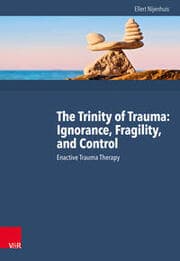
Enactive Trauma Therapy
The present book presents a unique understanding and approach to the enactive treatment of chronically traumatized individuals. Patients and clinicians are viewed as equal partners engaging in the action of participatory sense-making of a hurting world nearly beyond comprehension.
€85.00
(inklusive MwSt.)
Verfügbarkeit: Besorgungstitel, Festbezug
Zusatztext
Enactive trauma therapy is grounded in so-called enactivism, which holds that, like anyone else, traumatized individuals are (1) embrained, embodied, and environmentally embedded; (2) constitute biopsychological organism-environment systems that are essentially interested in preserving their existence; (3) are primarily affective and oriented toward making sense of things. Individuals exhibit a phenomenal self, world, and self-of-the-world through self- and world-oriented actions. They do not act on the basis of knowledge, but possess knowledge on the basis of world-engaged sensorimotor, affect-laden, and goal-oriented actions. Whenever interpersonal traumatization by significant others occurs, individuals may get caught up in affective and relational conflicts they cannot resolve on their own. Their generation and maintenance of a trauma-related dissociation of the personality involves a kind of sense-making that supports their continued existence when their capacity to integrate traumatic experiences is still too low. However, what starts as a courageous effort to navigate a traumatizing life may at some point in time become a serious problem. Enactive trauma therapy comprises the collaboration of two organism-environment systems: the patient and the therapist. Together they spawn new meaning and adequate actions - an interaction that resembles dancing: It takes pacing, mutual attunement, good timing, a sensitivity to balance, movement and rhythm, courage, as well as the ability and willingness to follow and lead.
Autorenportrait
<p>Ellert R. S. Nijenhuis, Ph.D., ist Psychologe, Psychotherapeut und wissenschaftlicher Forscher. Seit mehr als 30 Jahren ist er mit der Diagnostik und Behandlung schwer traumatisierter Patientinnen und Patienten befasst. Er lehrt und schreibt umfassend über die Themen »traumaverwandte Dissoziation« und »dissoziative Störungen«. Er ist wissenschaftlicher Berater der Clienia Littenheid in der Schweiz und arbeitet mit mehreren europäischen Universitäten zusammen. Die Internationale Gesellschaft für Studien über Trauma und Dissoziation verlieh ihm mehrere Preise, darunter eine Auszeichnung für sein Lebenswerk.</p>
Weitere Details
Erschienen: 03.04.2017
Umfang: 505 S., 33 Illustr., 7 Tab., 26 Abb., with 26 figu
Sprache: ENG
Einband: GEB
Format: 4 x 24.5 x 18 cm
ISBN/EAN: 9783525402689
Umbreit-Nr.: 9672668
