
China in South Sudan
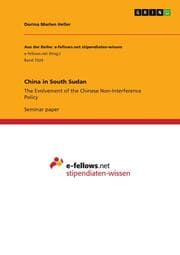
The Evolvement of the Chinese Non-Interference Policy, Aus der Reihe: e-fellows.net stipendiaten-wissen
€17.95
(inklusive MwSt.)
Verfügbarkeit: Titel wird für Sie produziert, Festbezug, bitte vormerken
Zusatztext
Seminar paper from the year 2018 in the subject Orientalism / Sinology - Chinese / China, grade: 1.7, University of Heidelberg (Institut für Sinologie), course: Chinesische Außenpolitik (1918-2018), language: English, abstract: In this paper, Chinas history of evolving involvement in Sudan and South Sudan and its role as a stakeholder throughout periods of conflict and civil war will be explored. Chinas foreign policy actions in South Sudan, its motivations and limitations will also be analysed. In conclusion, it will be attempted to situate the case of South Sudan in Chinas wider foreign policy. Chinas engagement in Africa is often harshly criticised by Western media and seen as exploitative and neo-colonialist. Undoubtedly the impact of Chinese involvement in Africa has been both positive (investments in infrastructure, new jobs, economic growth) and negative (legitimising autocratic regimes, monopolisation of resources, unequal partnerships). South Sudan is a particularly interesting case study because it has been used as a testing ground for Chinas proactive diplomacy. South Sudan is simultaneously the worlds youngest and most fragile state. Most Western countries consider Sudan and by extension South Sudan to be - an aid recipient, an abuser of human rights, and a former colony of Egypt and Great Britain. However South Sudan is rich in terms of its oil reserves. This has both been a blessing and a curse for the young nation: On the one hand almost all of the countrys revenues stem from oil production, on the other hand it meant that South Sudan invested disproportionally in the securement of its oil resources, but not in education, public health or infrastructure. This in turn has led to an unparalleled dependence on oil: There is no oil-exporting country in the world so dependent on this one commodity for its revenue (Medani 2013:28). Oil is also what originally brought China to Sudan and then South Sudan. The economical dimension cant be separated from the political here, in South Sudan we find a striking coexistence of actual political and aspirational economic relations (Large 2014:41). This interwovenness of political and economic interests has proven to be an increasing challenge for Chinas traditional policy of non-interference (bùganshè zhèngcè). In the last few years South Sudan has been the site of an evolving, experimental and more proactive Chinese political and security engagement.
Weitere Details
Erschienen: 02.01.2020
Umfang: 32 S., 1 farbige Illustr.
Sprache: ENG
Einband: KT
Format: 0.3 x 21 x 14.8 cm
ISBN/EAN: 9783346103857
Umbreit-Nr.: 8629279
