
Granite Skyscrapers
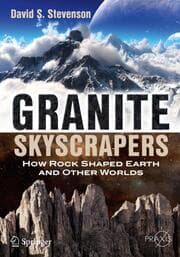
How Rock Shaped Earth and Other Worlds, Springer Praxis Books - Popular Astronomy
€40.65
(inklusive MwSt.)
Verfügbarkeit: Besorgungstitel, Festbezug
Zusatztext
In this book, David Stevenson offers us a look at the evolution of planets as they move from balls of mixed molten rock to vibrant worlds capable of hosting life. Granite is the key rock in the creation of complex, intelligent organisms on our world and very likely on other planets as well. This book summarizes the interdisciplinary research surrounding this process, painting a picture of biological evolution in partnership with geological evolution. The findings illustrate how the nature of a planet's surface has profound consequences for many of its other features, ultimately assisting or hindering the development and diversification of life. Linking together the geology of a planet and its contribution toward the evolution of living organisms has been a missing gap in popular astronomy. Stevenson synthesizes what we know about one key rock that dominates our world and that may be indirectly responsible for the existence of intelligent living beings. This is a hot topic currently being investigated in academic circles around the world, and so this book serves as a great primer for anybody interested in discovering how geology determines biology and its underlying evolutionary processes.
Autorenportrait
David Stevenson was born in Paisley, Scotland, in 1968. He studied Molecular Biology at Glasgow University and obtained a PhD in Genetics from the University of Cambridge. He then studied Astronomy and Planetary Sciences and Geophysics and Geochemistry (S267) at the OU. After a stint in academia, he became a teacher, but continued to write science articles for various publications. In July 2007 an article on Type Ia Supernovae, A Bigger Bang, was published in Sky & Telescope, with a second article on supernovae published in the same magazine in October 2011. Three books have followed on supernovae, red dwarf stars and star clusters (Extreme Explosions, Under a Crimson Sun and The Complex Life of Star Clusters, respectively). A further article on stellar mergers is at the production stages with Astronomy magazine, while a spin-off article from Extreme Explosions, Supersized Stellar Mystery, was published in Popular Astronomy in February 2014. Despite a background in Biology, the authors father inspired his interest in Astronomy from an early age. Many parallels can be drawn between the lives of people and those of stars. Exploring the cross-roads of different scientific disciplines is a key interest and motivation in both teaching and writing. His publishing history includes peer-review Biological research articles from 1999-2009, including an article on the early development of life, The Origin of Translation published in the Journal of Theoretical Biology (Elsevier Press) and an article on the discovery of antibiotic resistance genes in plants, published in Plant Physiology; numerous articles published on the Blackwell Plant Sciences website 2002-2007; Turning out the Lights - Popular Astronomy August, 2003; A Bigger Bang Sky & Telescope, July 2007; Exceptional Explosions, Sky & Telescope, October 2011; Extreme Explosions and Under a Crimson Sun books, Springer 2013; "Supersized Stellar Mystery", Popular Astronomy, January 2014; "The Complex Life of Star Clusters", Springer, May 2015; and Stellar Mergers in production with Astronomy magazine, [due July 2016;] "The Exo-weather Report", Springer, is due in Summer 2016.
Weitere Details
Erschienen: 17.08.2018
Umfang: xii, 374 S., 11 s/w Illustr., 70 farbige Illustr.,
Sprache: ENG
Einband: KT
ISBN/EAN: 9783319915029
Umbreit-Nr.: 4985435
