
Decentralisation and Regional Development
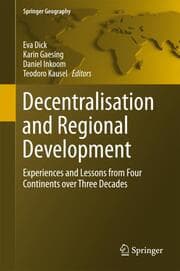
Experiences and Lessons from Four Continents over Three Decades, Springer Geography
Eva Dick/Karin Gaesing/Daniel Inkoom et al
€106.99
(inklusive MwSt.)
Verfügbarkeit: Besorgungstitel, Festbezug
Zusatztext
The authors analyze decentralisation and regional development paths and success factors in different governance sectors in Ghana, the Philippines, Tanzania, and Chile and discuss overarching aspects of relevance. Decentralisation, referring to the delegation of administrative responsibilities, political decision-making and fiscal powers to lower levels of government is today considered one of the most efficient engines of development. In Sub-Sahara Africa decentralised states have made more progress in reducing poverty as compared to states with a lower decentralisation score. But in many countries decentralisation is still considered 'work in progress' with unsatisfactory results. From a spatial point of view, the link between decentralisation and regional and district development is particularly interesting. Both in the North and in the South, regional or district development is attributed potential for advancing social and economic development, even more so in decentralised policy settings. Space-based networks on regional or district levels are considered instrumental for responding to locally specific challenges e.g. in economically lagging areas.
Weitere Details
Erschienen: 23.06.2016
Umfang: xxx, 185 S., 11 s/w Illustr., 15 farbige Illustr.,
Sprache: ENG
Einband: GEB
ISBN/EAN: 9783319293653
Umbreit-Nr.: 8954926
