
The Reception of Positivism in Spain
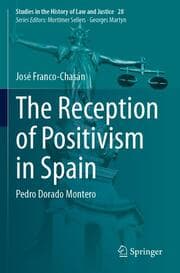
Pedro Dorado Montero, Studies in the History of Law and Justice 28
€149.79
(inklusive MwSt.)
Verfügbarkeit: Besorgungstitel, Festbezug
Zusatztext
Pedro Dorado Montero was one of Spains most relevant authors. He contributed to modern Criminal law and Penology with a very unique theory: the Protective Law for Criminals. In a time when neoclassical penal theories and new positivist theories clashed, Dorado Monteros proposal served as a bridge between the criminal law conceptions of the 19th and 20th centuries.In order to explore his role in the introduction of positivism within Spain and the subsequent success of this trend, this book addresses several aspects. The first three analyzed are his scholarly career, the historical and international context in which he lived, and the various European and other international influences he was exposed to. On this basis, two major points are then discussed.Firstly, Dorado Montero has been traditionally included within the movement known as correccionalismo. However, his legal-philosophical and criminal thought indicates otherwise. It seems to lie closer to positivism than to neoclassical positions. This research aims at challenging the accuracy of the eclectic label which traditional historiography has applied to him.In turn, Dorado Montero described a reality in which every moral value and legal representation was a mere product of mankinds imagination. Man is responsible for the elaboration of morals, law and culture in his own mind. Thus, for him, there were as many moral and legal orders as there were human beings on the planet. Such a claim is polemic even today. Unsurprisingly, the author received criticism from both neoclassical and positivist schools. Thus, the existence of a Doradian positivism is explored. Despite the growing interest in these topics over the last few decades, Dorado Montero has somehow been overlooked - even though his Derecho protector de los criminales described the criminal law of the future as well, one that will have to face the new neurological, medical, psychological and genetic challenges of our time.
Autorenportrait
José Franco-Chasán is Professor of Legal History at the University Rey Juan Carlos (Madrid). He obtained his PhD at the University of Valencia (cum laude and an international honour), where he obtained as well his Master in Human Rights. He worked as a researcher at the University of Augsburg (Germany) for three years. He has carried out several international research stays in Lausanne (Switzerland), Princeton (USA) and the Max-Planck-Institut (Frankfurt am Main, Germany). He worked at the University CEU Cardenal Herrera where he led the Department of Roman Law. Currently, he is working at the Emerging Research Group in Spain and Spanish America: Five Centuries of Historical and Legal Relations (University Rey Juan Carlos, EHCSRHJ) and in The Alan Watson Group: the Making of the Western Law (University of Valencia, WESTLAW).
Weitere Details
Erschienen: 25.11.2024
Umfang: x, 226 S.
Sprache: ENG
Einband: KT
ISBN/EAN: 9783031464379
Umbreit-Nr.: 5012147
