
Nineteenth-Century Poetry and the Physical Sciences
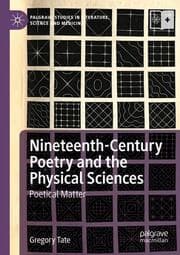
Poetical Matter, Palgrave Studies in Literature, Science and Medicine
€90.94
(inklusive MwSt.)
Verfügbarkeit: Besorgungstitel, Festbezug
Zusatztext
Poetical Matter examines the two-way exchange of language and methods between nineteenth-century poetry and the physical sciences. The book argues that poets such as William Wordsworth, Mathilde Blind, and Thomas Hardy identified poetry as an experimental investigation of natures materiality. It also explores how science writers such as Humphry Davy, Mary Somerville, and John Tyndall used poetry to formulate their theories, to bestow cultural legitimacy on the emerging disciplines of chemistry and physics, and to communicate technical knowledge to non-specialist audiences. The books chapters show how poets and science writers relied on a set of shared terms (form, experiment, rhythm, sound, measure) and how the meaning of those terms was debated and reimagined in a range of different texts. A stimulating analysis of nineteenth-century poetry and physics. In this groundbreakingstudy, Tate turns to sound to tease out fascinating continuities acrossscientific inquiry and verse. Reflecting that the processes of the universe werethemselves rhythmic, he shows that a wide range of poets and scientists werethinking through undulatory motion as a space where the material and the immaterialmet. The motion of waves, Tate demonstrates, was the exemplary form inthe physical sciences. Sound waves, light, energy, and poetic meter were eachcharacterized by a process of undulation, that could be understood as both aphysical and a formal property. Drawing on work in new materialism and newformalism, Tate illuminates a nineteenth-century preoccupation with dynamic patterningthat characterizes the undulatory as (in John Herschels words) not things,but forms.Anna Henchman, Associate Professor of English at Boston University, USAThis impressive study consolidates and considerably advances the field of physicsand poetry studies. Moving easily and authoritatively between canonical and scientistpoets, Nineteenth-Century Poetry and the Physical Sciences draws scientificthought and poetic form into telling relation, disclosing how they were understoodvariously across the nineteenth century as both comparable and competingways of knowing the physical world. Clearly written and beautifully structured,Nineteenth-Century Poetry and the Physical Sciences is both scholarly and accessible,a fascinating and indispensable contribution to its field.Daniel Brown, Professor of English at the University of Southampton, UKEssential reading for Victorianists. Tates study of nineteenth-century poetry andscience reconfi gures debate by insisting on the equivalence of accounts ofempirical fact and speculative theory rather than their antagonism. Theundulatory rhythms of the universe and of poetry, the language of science and ofverse, come into newrelations. Tate brilliantly re-reads Coleridge, Tennyson,Mathilde Blind and Hardy through their explorations of matter and ontologicalreality. He also addresses contemporary theory from Latour to Jane Bennett. Isobel Armstrong, Emeritus Professor of English at Birkbeck, University of London, UK
Autorenportrait
Gregory Tate is a lecturer in Victorian literature at the University of St Andrews, and the author of The Poets Mind: The Psychology of Victorian Poetry 1830-1870 (2012).
Weitere Details
Erschienen: 26.08.2021
Umfang: xi, 271 S.
Sprache: ENG
Einband: KT
ISBN/EAN: 9783030314439
Umbreit-Nr.: 2463211
