
Young People and Thinking Technologies for the Anthropocene
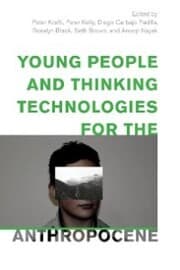
eBook - Children and Young People in the Anthropocene
Peter Kraftl/Peter Kelly/Diego Carbajo Padilla u a
ROWMAN & LITTLEFIELD PUBLISHERS
€113.95
(inklusive MwSt.)
Verfügbarkeit: Lieferbar
Zusatztext
<p><span>This collection, which is a companion volume to</span><span>Young People and Stories for the Anthropocene</span><span> (Kelly et al., 2022), aims to find, to explore, and to co-produce ways of staying with the trouble (Haraway 2016) that are disruptive of orthodoxies in childhood and youth studies, and productive of new ways of thinking, and of being and becoming, in the circumstances that we (young and old) find ourselves in. Circumstances that have, problematically, been identified as the Anthropocene, and which have been characterised as being situated at the convergence of the climate crisis, the 6</span><span><sup>th</sup></span><span> mass extinction, and the ongoing crises of global capitalism as earth system (Braidotti 2019, Moore 2015).</span></p><p></p><p><span>The collection emerges, in part, and among other things, around three key challenges. First, how can childhood and youth studies tell stories about the less obviously-bounded, obviously-crafted, obviously-engineered material stuff that humans create and that circulates stuff like plastics, chemicals, and the scattered remnants of past industrial endeavour. Second, the need to experiment with diverse modes of representation: with differently-mediated technologies and modes of telling that, from digital film platforms to childrens non-fiction writing, expand our lexicon in terms of how it might become possible to narrate young people in/and the Anthropocene. Third, the need to articulate different tools for working with young people in the Anthropocene. Tools and technologies, understood in this manner, are modes of becoming-attuned to, and of making, new configurations of human and non-human, new and pressing threats that weigh upon young people in visceral, affective ways, and new modes of speculating about and becoming-responsible for futures human and more-than-human. In this sense, the contributions to the collection, from scholars from the Anglo and non-Anglosphere, are framed by an urgency to develop and deploy innovative, critical and disruptive theoretical and methodological tools and technologies to identify and explore the material, temporal and conceptual challenges for children and young people, and those who research in childhood and youth studies, at this convergence.</span></p><p></p><p></p>
Autorenportrait
<p><span>Peter Kraftl</span><span> is Professor of Human Geography at the University of Birmingham, UK. His research looks at the intersection between children, young people and the environment, with a particular interest in urban and education spaces. He has published ten books (most recently,</span><span>After Childhood</span><span>, Routledge) and over 100 journal articles and book chapters on these topics. Peter has been an Editor of the journals</span><span>Childrens Geographies</span><span> and</span><span>Area</span><span> and is a Fellow of the Academy of Social Sciences (UK).</span></p><p></p><p><span>Peter Kelly</span><span>is a Professor of Education in the School of Education at Deakin University. Peters current research interests include a critical engagement with young people, their well-being, resilience and enterprise, and the challenges associated with the emergence of the Anthropocene. In the context of the COVID-19 pandemic, these interests are framing the development of a research agenda titled: COVID-19 and Young Peoples Well-being, Education, Training and Employment Pathways: Scenarios for Young Peoples Sustainable Futures.</span></p><p></p><p><span>Diego Carbajo Padilla</span><span>is an assistant professor and researcher of the Department of Sociology and Social Work at the University of the Basque Country UPV/EHU (Spain). His main research interests articulate concepts such as youth, precarity and/or entrepreneurship. These interests are concretised in publications around the concept of global grammars of entreprise, young peoples residential transitions and the squatter social movement in the Basque Country.</span></p><p></p><p><span>Rosalyn Black</span><span> is a Senior Lecturer within the School of Education at Deakin University, Australia. Her research interests meet at the intersection of the sociologies of education and youth. It draws on poststructuralist perspectives to critically analyse young peoples relationship to democratic systems; the role of schools and universities in constructing young people as citizens; and the geographies of young peoples lived experiences of citizenship, especially in contexts of social inequality.</span></p><p></p><p><span>Seth Brown</span><span> is a Lecturer in the School of Education at RMIT University, Australia.</span><span>His research interest is in the socio-cultural studies of education and youth in the context of wider social and cultural change. He is Head of UNEVOC@RMIT University and a member of Co-Lab SDGs and the Young Peoples Sustainable Futures Lab. His most recent jointly written book includes</span><span>Belonging, Identity, Time and Young Peoples Engagement in the Middle Years of School</span><span> with co-authors Peter Kelly and Scott Phillips (Palgrave Macmillan 2020).</span></p><p><span>Anoop Nayak</span><span> is Professor in Social and Cultural Geography at Newcastle University, UK. His research interests include race, ethnicity and migration; youth cultures and social class inequalities; masculinities and global transformations. His current research explores young people, diversity and belonging in a post-Brexit age (Research Excellence Academy) and an ESRC co-production award seeking to develop new templates for masculinities in primary schools.</span></p><p></p>
Weitere Details
Erschienen: 26.09.2022
Umfang: 206 S.
Sprache: ENG
ISBN/EAN: 9781538153635
Umbreit-Nr.: 8691101
